
Foundation repair in Birmingham costs $4,000–$15,000 for most full repairs, $3,500–$12,000 for slab work, $1,200–$3,000 per pier, $1,500–$6,000 for drainage, and $400–$1,500 for crack repair. The elevation survey that decides which is free.
What each range buys, the two variables that separate bids here, and the four warranty questions worth more than the price difference.
Birmingham foundation prices by job
| Job | Typical range | What it covers |
|---|---|---|
| Full repair with piering | $4,000–$15,000 | Survey-designed layout over the filled half, driven to bearing, load tested, per-pier logs |
| Individual piers | $1,200–$3,000 each | Push piers, set by structure weight and access |
| Helical piers | $1,400–$3,200 each | Torque recorded per pier — light structures, additions, undocumented fill |
| Slab repair | $3,500–$12,000 | Perimeter support across a cut-and-fill line, releveling, cosmetic work last |
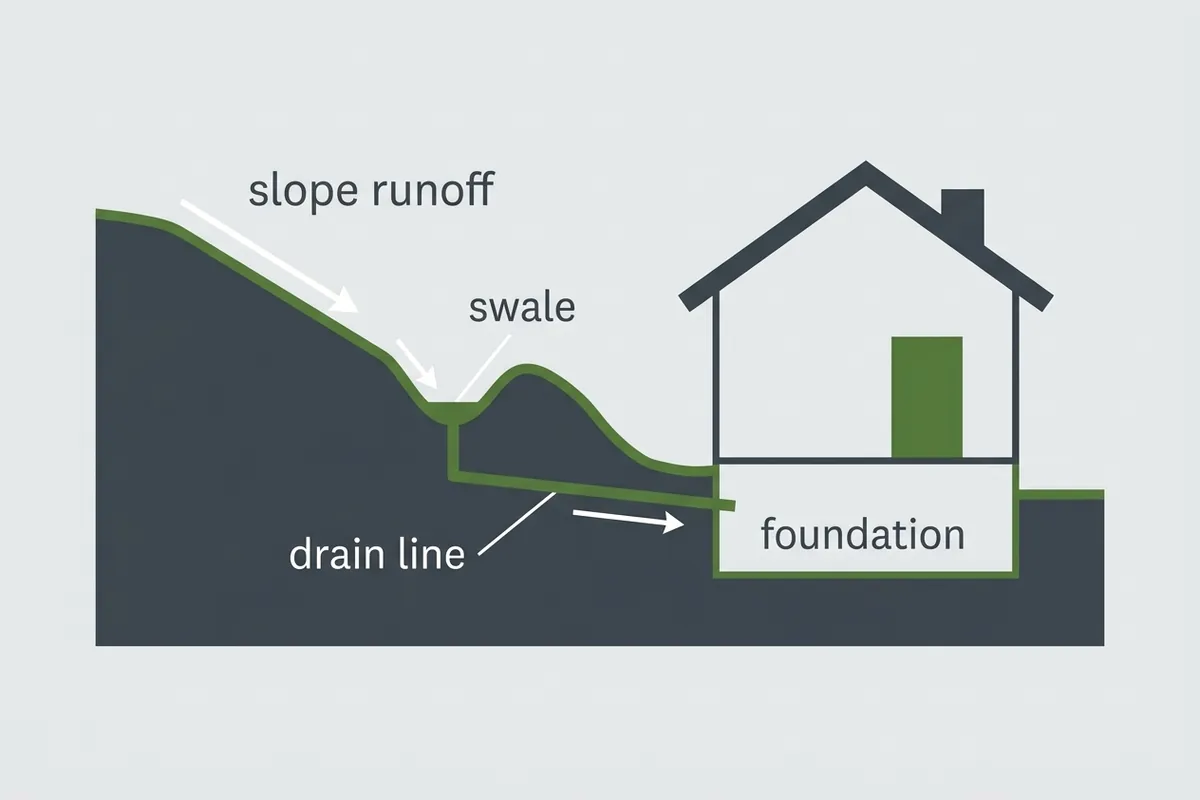
| Drainage correction | $1,500–$6,000 | Downspouts, regrading, uphill interception, perimeter drain and sump |
| Crack repair | $400–$1,500 | Epoxy or polyurethane injection, carbon fiber where a wall needs restraint |
| Concrete leveling | $500–$2,500 | Polyurethane lifting for drives, patios, walks, and porch slabs |
| Retaining wall work | Quoted separately | Priced on its own where a wall is holding the uphill side of a pad |
| Reading a competitor’s warranty | Free | We will sit down and go through it clause by clause, whoever wrote it |
The four warranty questions
Every national foundation brand competes in this metro, which is genuinely good for homeowners — you will get multiple bids without effort. The difficulty is that those bids arrive with warranty documents that sound similar and differ substantially. These four questions do more to separate them than the prices on the front page.
- What does it actually cover? Most foundation warranties cover the piered section holding its design load, not the house. That is a reasonable promise, but it is not the promise most homeowners believe they are buying, and the distinction only surfaces when an unpiered section moves later.
- Does it transfer, and at what cost? Some transfer once at no charge. Some charge a fee. Some allow only the first subsequent owner. Some do not transfer. If you might sell inside a decade, this clause can be worth more than the difference between two bids.
- Who stands behind it? A warranty backed only by the installing company is worth exactly what that company’s continued existence is worth. Third-party backed warranties cost more to issue and mean more. Ask which yours is.
- What can void it? Many warranties carry maintenance obligations — drainage upkeep, grading, sometimes a requirement to notify within a set window. Obligations you did not know you had are the most common route to a denied claim.
Bring us any proposal and we will read the warranty with you line by line at no charge, including — especially — if you end up hiring whoever wrote it. In a market this crowded, being the company that helps you understand the paperwork is a better use of an hour than being the company with the lowest number.
The two variables that separate honest bids
Pier count has to trace back to an elevation contour rather than to wherever damage happens to be showing. Eight piers on one proposal and sixteen on another are not two prices for one job — they are two incompatible readings of the same house, and at least one of them is mistaken. Ask each company to produce the measurements that generated its number.
Depth is an assumption until the drive happens, and on a filled hillside pad it is a consequential one. A bid that states no depth assumption and no per-foot overage rate has left itself room that a bid stating both has not. The cheaper number is frequently the one that has not committed to anything.
What else moves your estimate
- How much of the footprint sits over fill — the single biggest driver here
- Access — steep Over the Mountain lots and tight older streets cost more to work
- Lift versus stabilize — stopping movement costs less than recovering elevation
- Retaining walls — a separate scope, sometimes the more urgent one
- Interior finish restoration — usually a separate trade and a separate number
- Whether the builder warranty is still open — occasionally reduces your cost to nothing
When the cheap answer is the right answer
More often than a market this competitive tends to admit. On early movement with a near-flat survey, correcting where water goes genuinely is the whole repair, and on red clay that responds to 56.6 inches a year it is a structural act rather than a stopgap. Extending downspouts and rebuilding six feet of grade runs a few hundred dollars and is sometimes everything a house needs.
If the total is more than this year allows
Stage it, in this order: handle the water, stabilize whichever zone is worst, come back for the remainder, leave drywall and paint until last. Sequenced that way nothing has to be undone. The one stage that must not be deferred is the water, because on clay this reactive every section you have not yet supported keeps taking the same moisture swings while it waits. Ask for firm pricing against each stage — we write them that way whenever somebody asks.
Price, answered plainly
What is the average foundation repair cost in Birmingham?
Averaging these produces a number matching no actual house, because the categories hardly overlap. Separately: drainage $1,500-$6,000, cracks $400-$1,500, concrete leveling $500-$2,500, slab work $3,500-$12,000, full piering $4,000-$15,000. Which category yours falls into comes out of a free elevation survey.
Why do four Birmingham bids differ by thousands?
Pier count, depth assumption, and warranty scope. Count should come from an elevation contour rather than from visible cracks. Depth is an assumption until the drive happens, so it needs a stated per-foot overage rate. And warranty scope varies enormously between companies competing here.
What should I ask about a lifetime warranty?
Four things. What it covers - the piered section holding its design load, or the house generally. Whether it transfers on sale, how many times, and at what cost. Whether it is backed by a third party or only by the company. And what maintenance obligations of yours could void it.
Is the cheapest bid ever the right one?
Sometimes, and we will say so. On early movement with a near-flat survey, correcting drainage genuinely is the whole repair. Be careful when a bid is low because it assumes a shallow depth on a filled pad - that is not a discount, it is an assumption that gets revised once equipment is in your yard.
Does insurance pay for any of it?
Rarely. Alabama policies exclude earth movement, which covers both fill consolidation and clay movement. The exception is damage from a sudden accidental plumbing discharge. On a newer home, the builder warranty is usually a more promising route than the insurance policy.
Do you charge for the evaluation?
We don't charge for the evaluation, and that includes reading somebody else's proposal with you. Floor elevation readings, dated crack measurements, the exterior water walk, and a written scope with fixed line prices are all free - as is going through a competitor's warranty clause by clause at your kitchen table.
Get a free Birmingham foundation evaluation
Describe what the house is doing — a crack that keeps opening, a door that stopped latching, floors that fall away toward one side, a retaining wall starting to lean. If you already hold a bid from somebody else, bring it and we will go through the warranty with you. Same working day reply.